
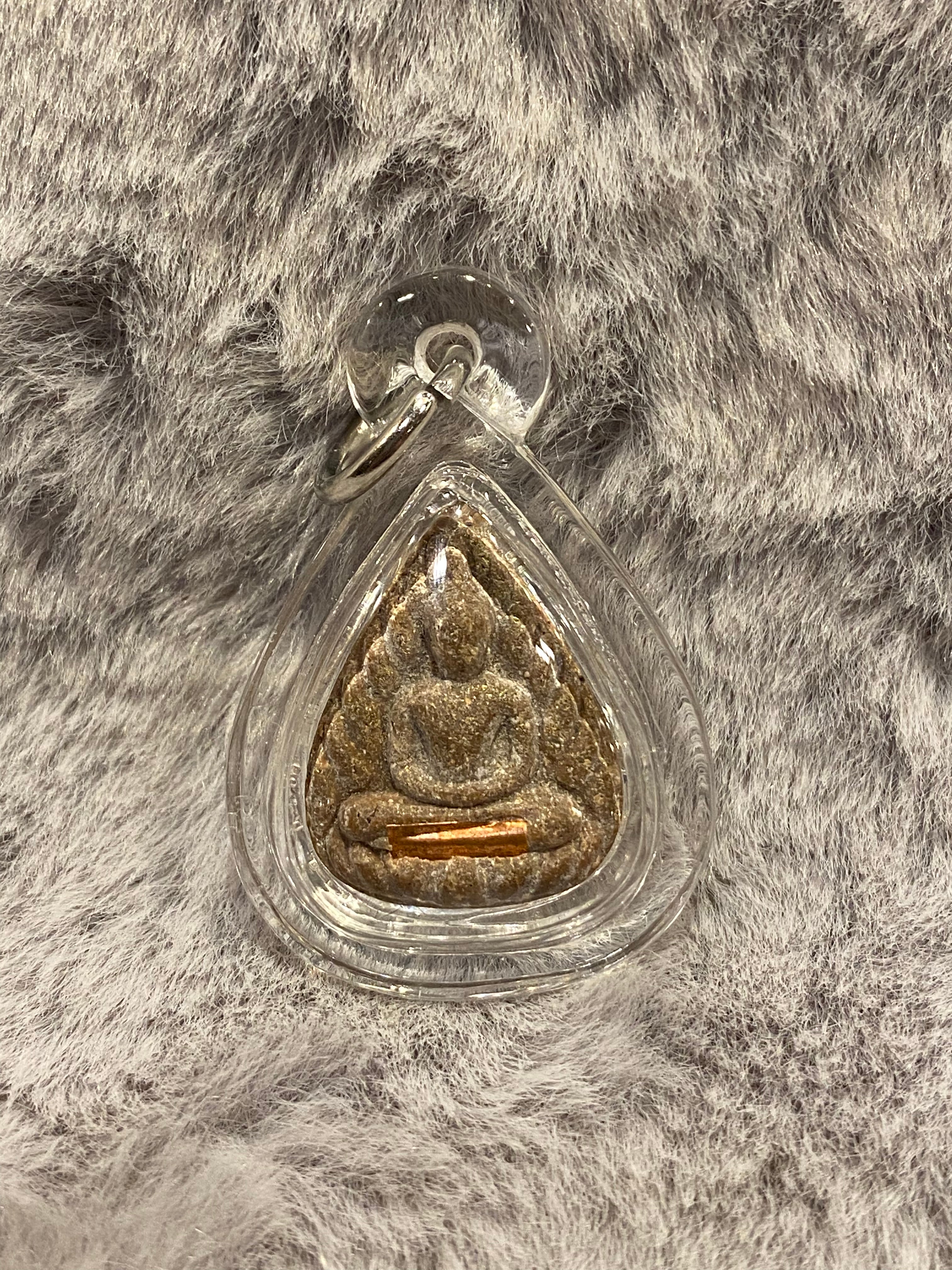
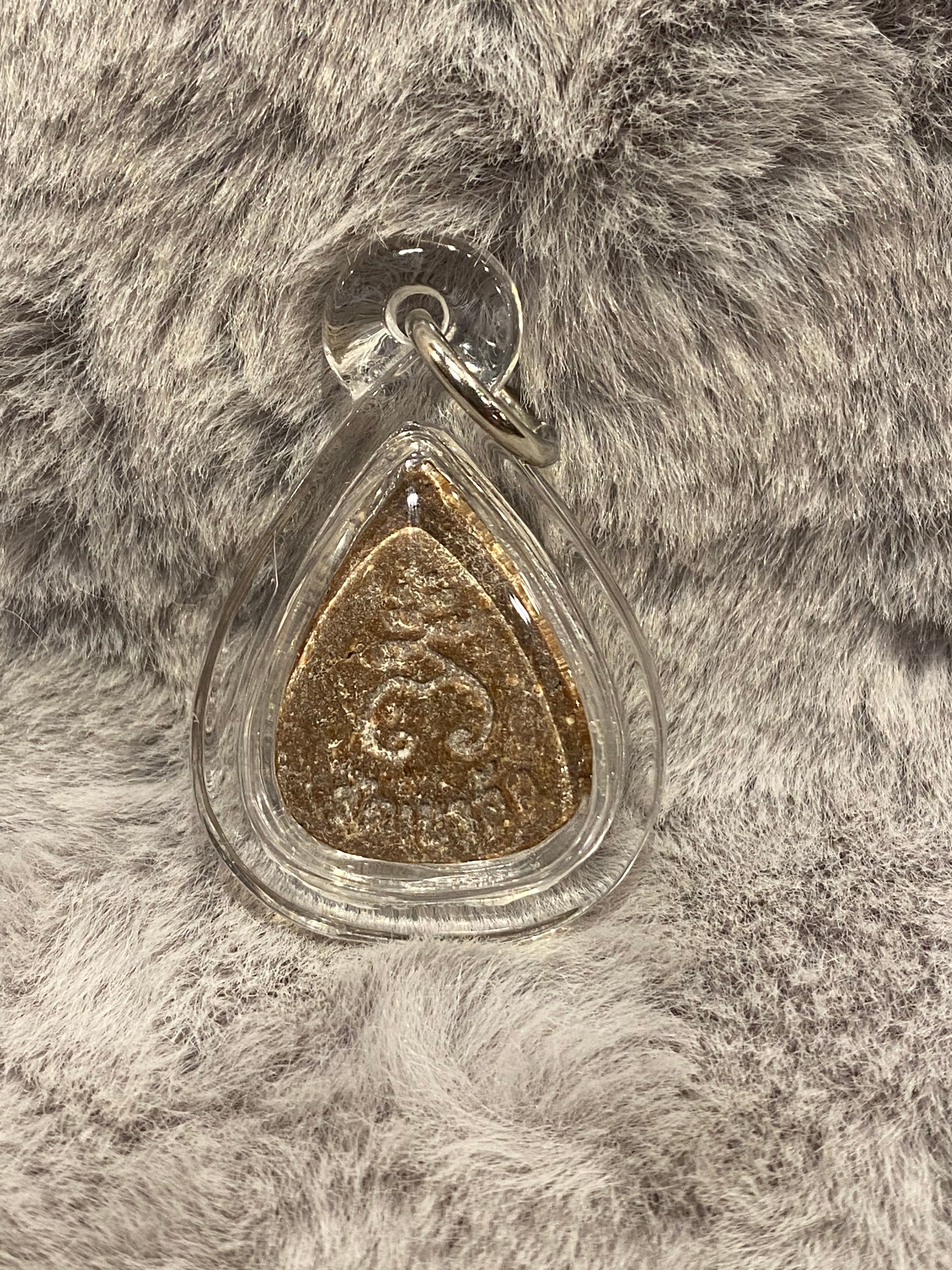
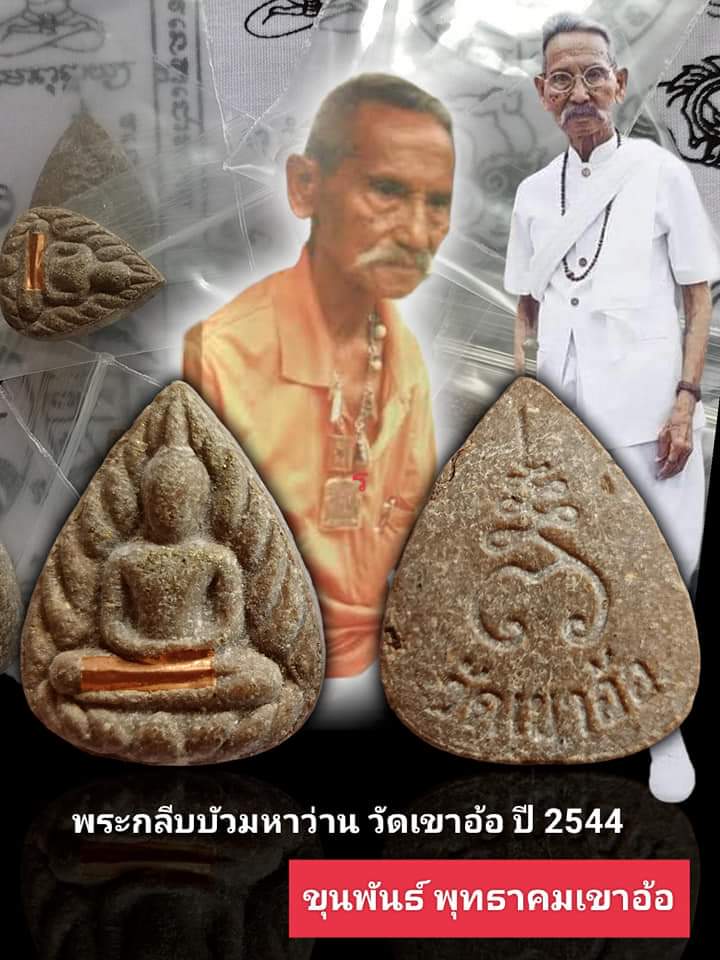
[Protecting from evil, warding off danger, attracting wealth, improving interpersonal relationships, ensuring safety; suitable for anyone to wear] Lotus Buddha Ajarn Khun Pan, BE 2544, Wat Khao Aor
[Master] Ajarn Khun Pan / Ajarn Guan Spray
[Temple] Wat Khao Aor
[Year] Buddhist Era 2544
【size】 2.4 cm high * 2 cm wide * 1.4 cm thick.
[Sacred Relic Materials] Holy powder, temple clay, talisman tube
[Efficacy of Sacred Objects]
The Buddha is primarily believed to ward off evil, protect from danger, attract wealth, improve interpersonal relationships, and ensure safety. Some even believe that the Buddha is the founder of Buddhism, so wearing a Buddha pendant is said to have more significant effects than other pendants, making it suitable for anyone.
It can bring peace and good fortune to the worshipper and their family, ward off misfortune and danger; attract benefactors and good relationships; attract wealth, protect against villains, improve luck, help business and career, and bring happiness.
[Introduction to the Sacred Relic]
Shakyamuni means the founder of Buddhism. The Buddha can have different forms, the most common being: the Emerald Buddha, the Fire Dragon Buddha, the Seven-Headed Buddha, the White Olive Buddha, etc. In Thailand, the Buddha is represented by seven different forms, each representing a different day of the week and its guardian deity.
The Buddha said, "I now speak of the world with my mere body of one fathom; the world arises, the world perishes, the world vanishes, and all traces of the Way are extinguished." Within this scope, the Buddha's suffering was no different from that of any ordinary person. In the Buddha's words, it was "the suffering of birth, the suffering of old age, and the suffering of sickness."
Approximately 2,500 years ago, the Buddha was born in Kapilavastu, a kingdom in central India. His father was King Suddhodana of the Shakya clan, and his mother was Queen Maya. His name was Siddhartha. At the age of sixteen, he married the beautiful royal woman Yasundara. In the palace, he enjoyed a life of immense material wealth and pleasure. Then, at the age of twenty-nine, when he suddenly faced the suffering of humanity, he abandoned his newborn son Rahula, his wife, and his kingdom, and renounced his worldly life by the Anuma River.
For the next six years, he underwent countless practices and asceticism. He first followed the meditator Alara Garan, and later Uddaka Ramaputta, but failing to attain ultimate wisdom, he left them and entered into a life of asceticism, including pacifying meditation and fasting. Still failing to gain wisdom, he then abandoned this path. At the age of thirty-five, the Buddha attained enlightenment under the Natsa tree by the Kayanirana River, having comprehended the Four Noble Truths, the Eightfold Path (Middle Way), and the law of dependent origination, thus establishing the wisdom of Bodhi.
After attaining enlightenment in Bodh Gaya, the Buddha decided to begin spreading his teachings. He first thought of the two great sages, Alara Garan and Uddaka Ramaputta. Upon learning of their passing, he set off for Sarnath in Varanasi to find the five followers who had lived ascetic lives with him. After the Buddha renounced his worldly life, the royal preceptor of Kapilavastu sent five men—Kaundinya, Bhadra, Bhava, Mahanama, and Asvashi—to join him and care for him. During the six years of the Buddha's ascetic practice, the five remained by his side. Later, when the Buddha abandoned asceticism and accepted food and drink from shepherdesses, the five mistakenly believed he had given up his spiritual path and left him to continue their ascetic practices in the Sarnath forest. The first sermon is reminiscent of the Gupta Sarnath school of Buddhism. Sarnath was an ancient place where emperors kept deer, and it contained a grove of ascetics. It is said that when the Buddha arrived at Sarnath, the five disciples, including Kaundinya, conspired to ignore him, believing he had ceased his ascetic practices and was no longer worthy of respect. However, when the Buddha instructed them, saying, "Whether a practitioner can realize the truth depends not on asceticism, nor on indulgent pleasures; neither extreme of suffering nor pleasure is the true cause of enlightenment," the five disciples were convinced and together took refuge in Buddhism.
This time, the Buddha stayed in Deer Park for three months. This was Shakyamuni's first sermon, known in Buddhist history as the "First Turning of the Wheel of Dharma." From then on, the Buddha lived and taught in the world from Deer Park, giving more than three hundred sermons and converting thousands of disciples.
The scene following the Buddha's first turning of the Wheel of Dharma is already described in a mythical way in the *Dhammapada Sutta*. The gods on earth cried out, "In the Deer Park in Varanasi, where the sage fell, the World-Honored One has turned the supreme Wheel of Dharma. No ascetic or Brahmin, no god, Mara or Brahma, no human being in the world can reverse it." The Four Heavenly Kings, hearing the cries of the earthly gods, echoed the same cry. Immediately, all the gods in heaven echoed the same cry, all the way to the Brahma realm; the entire universe trembled and shone with great light.
In later Buddhist scriptures, including the Pali Canon, some mythologized descriptions of the Buddha's first sermon were added. On the Buddha's journey to Sarnath, the Mahavagga and the Amitayus recount how the Naga king Suddhodana invited the Buddha to stay overnight and offered him food . When the Buddha reached the Ganges, he had no money to pay the ferry fee, so he used his supernatural powers to leap across the Ganges.
When the Buddha first turned the Wheel of Dharma for five monks, ten jeweled seats appeared on the ground for him to sit and preach. The Buddha sat on the Dharma seat, radiating great light that illuminated the three thousand great chiliocosms. The three thousand great worlds vibrated in six ways, revealing eighteen auspicious omens. Tens of thousands of Bodhisattvas, Indra, Brahma, and all the gods from the four cardinal directions and above and below came to pay homage to the Buddha's feet and listen to his teachings.
[Introduction to Ajarn Khun Pan]
Ajarn Khum Phan was the head of the 8th Police District in Thailand and the last civilian to receive an honorary title. He passed away at the age of 108, having dedicated over 70 years of his life to serving the country and its people. Known for his strong sense of justice and hatred of evil, he was a renowned crime fighter in Thailand and the spiritual leader of Nakhon Si Thammarar in southern Thailand. Besides his work as a crime fighter, Khum Phan was also a scholar well-versed in Thai culture, history, and folklore, and he authored numerous works, including a collection of essays written in fountain pen. Thailand's monarchy began under Ayutthaya and officially ended in 1932. "Khum Phan" is an honorary title bestowed by the King of Thailand, usually reserved for those with outstanding achievements. The title's heading carries a symbolic ranking, typically representing expertise or accomplishments in a particular area. Therefore, Khum Phan's honorary title, Phantharak Rajadej, is a respectful one, replacing his original name as a sign of esteem.
Khun Pan was born on February 18, 2441 BE (Buddhist Era) in Butr Phantharak, the second child in his family. His original name was Khun Pan Thanaratzeti. From a young age, his father taught him and his brothers basic grammar, indicating that Khun Pan would study Pali at a nearby temple. On his first day of school, the teacher gave him an IQ test. When he handed in his paper, the teacher said, "He'll go straight to second grade tomorrow." The next day, Khun Pan took a second test, and when he handed it in, the teacher again said, "Khun Pan, he'll go straight to third grade tomorrow." This achievement of advancing three grades in three days became a legendary tale, demonstrating Khun Pan's exceptional intelligence. Throughout his primary and secondary school years, Khun Pan consistently ranked at the top of his class and spent his free time studying metaphysics and magic with renowned masters. Later, he became a disciple of the Shaolin Temple in Southern Xinjiang and learned many magical arts from Wat Khao Or, the first temple of magic. He also personally experienced Wat Khao Or, such as being soaked in herbs and holy water, and chanting scriptures for several days and nights. In addition, his master tattooed talismans on his body, which is why he developed the invulnerability of swords and spears, and was even known as the "Iron-skinned Detective".
Khun Phan entered police academy at the age of 21, where he also learned various martial arts. After graduating five years later, he became a detective in Phatthalung province. This province was notoriously difficult to deal with, harboring many notorious thieves and a dark area that many police officers dared not venture into. But Khun Phan was fearless and chose to challenge the evil forces. In just five years, he successfully apprehended many notorious thieves, including Sang, Phu, Meng, Thong, Yo, and Ling. The state government truthfully reported Khun Phan's achievements to the King of Thailand, who later bestowed upon him the rank of Royal Hat Phetchaburi.
Back when Khun Pan wasn't so famous, he planted two scepters in the center of Hat Yai and Songkhla, changing the feng shui of the entire area. Indeed, Hat Yai and Songkhla, which were not prosperous at the time, became thriving. Any local elder would know this story.
When Khun Pan turned 30, he applied for a year's leave of absence to become a monk at Wat Mahathat. During his year of ordination, Khun Pan diligently studied Buddhist precepts. When he returned to secular life on an auspicious day a year later, many police chiefs came to welcome him. A month after his return, the Special Branch transferred Khun Pan to Naratiwat as a police chief. At that time, the state had a large Muslim population, and Khun Pan learned some Malay after arriving, enabling him to communicate with the people. The state was also known for a notorious thief with political connections and a background in magic, possessing invulnerability to weapons and committing countless atrocities, including robbery and murder, which the people lived in constant fear.
Upon learning of this, Khun Pan immediately made arrangements. After months of tracking, he finally caught up with the notorious bandit. After a fierce battle, each employing their own methods, the bandit was ultimately defeated by Khun Pan and imprisoned. Shortly afterward, the bandit committed suicide in prison, much to the relief of the residents. Khun Pan later served in several other states, capturing at least a hundred notorious bandits during his tenure—a feat unmatched to this day!
Khun Pan was known as the "Criminal Buster" in Thailand for cracking numerous major crimes and dismantling many large criminal groups. He was promoted to head of the 8th Police District in 2503 and retired in 2507. He later participated in many national activities and served as an advisor. In 2516, he was elected to the Senate and was a member of the Democrat Party. Khun Pan had 12 children and enjoyed a happy later life. He was healthy and free from illness and passed away peacefully on the 75th day of the 2549th year of his reign at the age of 108.
Because of his integrity and incorruptibility throughout his life, and his dedication to fighting crime, Khun Pan was deeply loved by the Thai people. He was also a highly accomplished Buddhist monk. After a hundred days of chanting and dedication ceremonies, his cremation was held on February 22, 2550 BE (Buddhist Era). Due to King Rama IX's poor health, a prince was specially dispatched to personally carry the royal cremation to bid farewell to this hero. On the day of Khun Pan's funeral, approximately 300,000 people went to pay their respects. Two days before the ceremony, many people had already flocked to Wat Mahathat Worra Maha Wiharn. The sheer number of people caused severe traffic congestion, forcing police to close major roads and advise people to walk to the funeral home. The scene was so grand that it was truly moving. Originally, the plan was to distribute Jatukam Ramathep amulets, which had been personally blessed by Khun Pan, on the day of the ceremony. However, because the number of attendees far exceeded expectations and many people fainted on the spot, the Jatukam Ramathep amulets were only given to important officials and members of the royal family who attended the funeral. In the end, Khun Pan's funeral was completed under the supervision of the royal family.
Besides his outstanding performance at work, Khun Pan is also highly accomplished in his personal spiritual practice. He has participated in the consecration ceremonies of many amulets, and Jatukam is Khun Pan's most special sacred object. It is extremely helpful for protection and safety, as well as for attracting wealth in business. It is a miraculous amulet that can bring success in anything one desires. The craze for it in Thailand has also spread to neighboring countries, and even Japan has felt its divine power, with NHK News giving it extensive coverage.